miércoles, 14 de octubre de 2009

Che è accaduto al Global Warming?

E' il titolo, provocatorio, in un articolo scientifico uscito ieri sulla BBC inglese, dove si ricorda che l'anno più caldo mai registrato risale oramai al 1998.

immagine articolo 16304

E' uscito ieri sul sito ufficiale della BBC News, il più famoso notiziario britannico, un articolo interessante, quanto provocatorio, sulla "fine" del Riscaldamento Globale, che, a quanto pare, è in fase di decrescita.

Anzitutto, si fa l'osservazione che le temperature globali non sono aumentate negli ultimi 11 anni, in quanto l'anno più caldo risale oramai al 1998, questo malgrado il forte aumento dei gas serra nell'atmosfera che si è nel frattempo misurato, che avrebbe dovuto condurre a record di caldo assoluti.

Due anni fa una ricerca della Royal Society tentò di dimostrare come l'aumento dell'attività solare avvenuto nel XX Secolo non potesse essere responsabile dell'incremento delle temperature terrestri, facendo un confronto con l'intensità dei raggi cosmici giunti sul nostro Pianeta negli ultimi 40 anni.

Ma lo scienziato solare Piers Corbyn ha invece recentemente sostenuto che l'impatto delle particelle cariche provenienti dal Cosmo, di intensità variabile sull'atmosfera terrestre a seconda dell'attività solare più o meno intensa, risulta essere maggiore di quanto finora creduto, e potrebbe essere il responsabile quasi per intero del riscaldamento intervenuto negli ultimi cinquant'anni.

La sua scoperta è, secondo l'autore, talmente importante da convocare un'apposita conferenza a Londra per la fine del mese.

Ma di fondamentale importanza per la regolazione delle temperature terrestri è il ruolo svolto dagli Oceani.

Una ricerca del Prof. Easterbrook della Western Washington University, sostiene che gli Oceani attraversano periodicamente cicli più caldi e più freddi, nell'arco di tempo variabile tra i 30 ed i 60 anni.

Il più importante è il ciclo delle oscillazioni della Pacific Decadal Oscillation, che è stata positiva per lungo tempo, mentre adesso, da pochi anni, ha iniziato a raffreddarsi.

Il periodo di raffreddamento globale compreso tra il 1945 ed il 1977 ha coinciso con una fase fredda della PDO, verso la quale ci stiamo avviando anche adesso.

Questo, stando al Prof. Easterbrook, il calo della PDO dovrebbe garantirci almeno 30 anni di raffreddamento globale!

Ma non tutti sono concordi con queste teorie.

Al britannico Met Office Hadley Centre sono ancora convinti della validità della Teoria del Riscaldamento Globale.

Dicono che nei loro modelli climatici tengono conto sia delle variazioni solari che dei cicli oceanici, e che quindi il Global Warming non procede in linea retta, ma attraverso oscillazioni, con pause ed anche brevi periodi di raffreddamento.

Ad ingarbugliare maggiormente la questione c'è la dichiarazione di Mojib Latif, un membro dell'IPCC, che dice che, effettivamente, potrebbe essersi innescato un meccanismo di raffreddamento del mondo della durata di 15 o 20 anni.

E' un membro di primo grado nell'IPCC, in quanto è uno dei massimi modellisti climatici, e lavora presso l'Istituto Leibniz di Scienze Marine dell'Università di Kiel, in Germania.

Secondo lui, tra 15 o 20 anni, allora l'effetto antropico vincerà quello naturale, ed il clima si riscalderà con un "effetto valanga".

Non concordano con lui, invece, gli esperti del Meteoffice, i quali affermano che, tra il 2010 ed il 2016, almeno tre anni saranno più caldi del 1998.

Ovviamente, gli scettici ribattono che invece è molto più probabile un raffreddamento, almeno fino al 2030.

Non ci resta che vedere quello che si verificherà nei prossimi anni, intanto, notiamo che, attualmente, le indicazioni di un arresto del Global Warming ci sono tutte, vediamo se si manterranno prossimamente.

L'articolo originale è all'indirizzo: http://news.bbc.co.uk/2/hi/science/nature/8299079.stm

lunes, 12 de octubre de 2009

Nel 2009 record di minor scioglimento dei ghiacci antartici!

Una pubblicazione ad opera di due studiosi sul Geophysical 

Research Letters, mostra che lo scioglimento dei ghiacci 

antartici nel 2009 è stato il più basso dal 1979, da quando si 

studiano le superfici glaciali via satellite.


immagine articolo 21023 immagine articolo 21023 Nella foto, scattata da Jerzy Strzelecki, sono immortalati i ghiacci antartici (Licenza GFDL). Il grafico (Fonte: www.worldclimatereport.com) mostra che quest'anno c'è stato il minimo scioglimento dei ghiacci antartici degli ultimi trent'anni.


Marco Rossi: 12-10-2009 ore 08:08
Da molto tempo si insiste sul terrore generato da scioglimenti di grandi quantità di ghiaccio in Antartide ed in Groenlandia, gli unici "Inlandsis" in grado di innalzare effettivamente il livello del mare con la loro liquefazione.
Pochi, infatti, sanno che il ghiaccio che circonda il Polo Nord poggia direttamente sul mare, per cui il suo totale scioglimento non porterebbe ad alcun aumento del livello del mare, esattamente come lo scioglimento di un cubetto di ghiaccio in un bicchiere non porta cambiamenti nel livello dell'acqua in esso.
Al contrario, le grandi calotte di ghiaccio, dello spessore di alcuni chilometri, presenti sull'Antartide e sulla Groenlandia, poggiano direttamente sulla terraferma, per cui il loro scioglimento effettivamente innalzerebbe in modo catastrofico il livello della superficie del mare nel quale finirebbero.
E' di ieri la notizia di una riunione del Governo delle Maldive effettuata... sott'acqua, proprio come forma di protesta contro l'effetto Serra ed il conseguente innalzamento del livello del mare (queste isole si trovano ad appena 6 metri di altezza sulla superficie oceanica).
Tuttavia, uno studio pubblicato sul Geophysical Research Letters, da parte degli studiosi Tedesco e Monaghan, della NASA, metterebbe in dubbio la presenza di questo incremento nello scioglimento dei ghiacciai antartici legato all'incremento della CO2 nell'atmosfera.
E' stato creato un indice standardizzato per definire lo scioglimento dei ghiacci antartici, costantemente misurati via satellite a partire dalla fine del 1979, e per il periodo di normale scioglimento dei ghiacci, cioè nei mesi che vanno da Ottobre a Gennaio.
Il grafico ottenuto dimostra come tale scioglimento sia chiaramente correlato con due fenomeni, l'ENSO (il ben noto Nino), ed il SAM (il Southern Emisphere Anular Mode), che causano dei "picchi" annuali.
Ma la sorpresa è che nell'Estate 2008-09 si è raggiunto il minimo scioglimento dei ghiacci di tutti gli ultimi trent'anni, ed inoltre non è presente alcun "trend" di aumento, anzi, semmai una lieve tendenza alla diminuzione, contraddicendo gli studi effettuati finora.
Anche i dati che indicano la superficie marina totale occupata dai ghiacci antartici non mostra alcuna tendenza alla diminuzione, presentando anzi un lieve aumento.
Tutto questo al contrario di quanto sta avvenendo sull'Artico, dove invece il trend di diminuzione dei ghiacci è evidente.
Queste notizie rendono ben presente quella che è la difficoltà a comprendere con esattezza il funzionamento della nostra macchina climatica, il che rende difficili le previsioni a scadenza più o meno lunga.
Bibliografia
Tedesco M., and A. J. Monaghan, 2009. An updated Antarctic melt record through 2009 and its linkages to high-latitude and tropical climate variability. Geophysical Research Letters, 36, L18502, doi:10.1029/2009GL039186.

domingo, 11 de octubre de 2009

Ocean Heat Content: Dropping again

I found Bob’s Arctic Ocean Heat Content graph quite interesting as it may explain why we are seeing a recovery in sea ice for the last two years. It also reminds me a lot of the graph seen of the Barents Sea water temperature plotted against the AMO which WUWT recently covered here.

Update of NODC (Levitus et al 2009) OHC Data Through June 2009

That worrisome “Methane Beast” apparently is still not awake.

OK Leland Palmer, I told you on several occasions where you tried to steer threads towards Methane that you should wait until WUWT had a thread that was relevant – here you go, have at it. – Anthony

The Ups and Downs of Methane

Reposted from World Climate Report

One of the indisputable facts in the field of global climate change is that the atmospheric build-up of methane (CH4) has been, over the past few decades, occurring much more slowly than all predictions as to its behavior (Figure 1). Since methane is a particularly potent greenhouse gas (thought to have about 25 times the warming power of CO2), emissions scenarios which fail to track methane will struggle to well-replicate the total climate forcing, likely erring on the high side—and feeding too much forcing into climate models leads to too much global warming coming out of them.


Figure 1. Atmospheric methane concentrations, 1985-2008, with the IPCC methane projections overlaid (adapted from: Dlugokencky et al., 2009)

Figure 2 shows the year-over-year change in the methane concentration of the atmosphere, and indicates not only that the growth rate of methane has been declining, but also that on several occasions during the past decade or so, it has dropped to very near zero (or even below) indicating that no increase in the atmospheric methane concentration (or a even a slight decline) occurred from one year to the next.

domingo, 4 de octubre de 2009

Wheel! – - Of! – - Silly!

I thought I’d seen the end of this after we first saw it back on May 26th of this year. I wrote then:

How not to make a climate photo op

You have to wonder- what were these guys thinking? The only media visual they could have chosen that would send a worse message of forecast certainty was a dart board…or maybe something else?

MIT’s “wheel of climate” – image courtesy Donna Coveney/MIT

But no, they apparently didn’t get enough press the first time around. I mean, come on, it’s a table top roulette wheel in a science press release. Today we were treated to yet another new press release on the press mailing list I get. It is recycled science news right down to the same photo series above which you can see again in the press link below. The guy on the left looks slightly less irritated in the new photo at the link. Next, to get more mileage, I think we’ll see the online game version.

So what I think we need now is a caption contest for the photo above. Readers, start your word skills. I’ll post the best three captions from comments in a new post later.

Oh and if you want to read about the press release, here it is below:

From MIT Public Release: 2-Oct-2009
There’s still time to cut the risk of climate catastrophe, MIT study shows

A new analysis of climate risk, published by researchers at MIT and elsewhere, shows that even moderate carbon-reduction policies now can substantially lower the risk of future climate change. It also shows that quick, global emissions reductions would be required in order to provide a good chance of avoiding a temperature increase of more than 2 degrees Celsius above the pre-industrial level — a widely discussed target.

How to limit risk of climate catastrophe

To illustrate the findings of their model, MIT researchers created a pair of ‘roulette wheels.’ This wheel depicts their estimate of the range of probability of potential global temperature change over the next 100 years if no policy change is enacted on curbing greenhouse gas emissions.
Photo – Image courtesy: MIT Joint Program on the Science and Policy of Global Change
Comprehensive analysis of the odds of climate outcomes under different policy scenarios shows significant benefits from early actions.
David L. Chandler, MIT News Office
October 2, 2009

A new analysis of climate risk, published by researchers at MIT and elsewhere, shows that even moderate carbon-reduction policies now can substantially lower the risk of future climate change. It also shows that quick, global emissions reductions would be required in order to provide a good chance of avoiding a temperature increase of more than 2 degrees Celsius above the pre-industrial level — a widely discussed target. But without prompt action, they found, extreme changes could soon become much more difficult, if not impossible, to control.

Ron Prinn, co-director of MIT’s Joint Program on the Science and Policy of Global Change and a co-author of the new study, says that “our results show we still have around a 50-50 chance of stabilizing the climate” at a level of no more than a few tenths above the 2 degree target. However, that will require global emissions, which are now growing, to start downward almost immediately. That result could be achieved if the aggressive emissions targets in current U.S. climate bills were met, and matched by other wealthy countries, and if China and other large developing countries followed suit with only a decade or two delay. That 2 degree C increase is a level that is considered likely to prevent some of the most catastrophic potential effects of climate change, such as major increases in global sea level and disruption of agriculture and natural ecosystems.

“The nature of the problem is one of minimizing risk,” explains Mort Webster, assistant professor of engineering systems, who was the lead author of the new report. That’s why looking at the probabilities of various outcomes, rather than focusing on the average outcome in a given climate model, “is both more scientifically correct, and a more useful way to think about it.”

Too often, he says, the public discussion over climate change policies gets framed as a debate between the most extreme views on each side, as “the world is ending tomorrow, versus it’s all a myth,” he says. “Neither of those is scientifically correct or socially useful.”

“It’s a tradeoff between risks,” he says. “There’s the risk of extreme climate change but there’s also a risk of higher costs. As scientists, we don’t choose what’s the right level of risk for society, but we show what the risks are either way.”

The new study, published online by the Joint Program in September, builds on one released earlier this year that looked at the probabilities of various climate outcomes in the event that no emissions-control policies at all were implemented — and found high odds of extreme temperature increases that could devastate human societies. This one examined the difference that would be made to those odds, under four different versions of possible emissions-reduction policies.

Both studies used the MIT Integrated Global Systems Model, a detailed computer simulation of global economic activity and climate processes that has been developed and refined by the Joint Program on the Science and Policy of Global Change since the early 1990s. The new research involved hundreds of runs of the model with each run using slight variations in input parameters, selected so that each run has about an equal probability of being correct based on present observations and knowledge. Other research groups have estimated the probabilities of various outcomes, based on variations in the physical response of the climate system itself. But the MIT model is the only one that interactively includes detailed treatment of possible changes in human activities as well — such as the degree of economic growth, with its associated energy use, in different countries.

Quantifying the odds

By taking a probabilistic approach, using many different runs of the climate model, this approach gives a more realistic assessment of the range of possible outcomes, Webster says. “One of the common mistakes in the [scientific] literature,” he says, “is to take several different climate models, each of which gives a ‘best guess’ of temperature outcomes, and take that as the uncertainty range. But that’s not right. The range of uncertainty is actually much wider.”

Because this study produced a direct estimate of probabilities by running 400 different probability-weighted simulations for each policy case, looking at the actual range of uncertainty for each of the many factors that go into the model, and how they interact. By doing so, it produced more realistic estimates of the likelihood of various outcomes than other procedures — and the resulting odds are often significantly worse. For example, an earlier study by Tom Wigley of the National Center for Atmospheric Research estimated that the Level 1 emissions control policy — the least-restrictive of the standards studied -would reduce by 50 percent the odds of a temperature increase of more than 2 degrees C, but the more detailed analysis in the new study finds only a 20 percent chance of avoiding such an increase.

One interesting finding the team made is that even relatively modest emissions-control policies can have a big impact on the odds of the most damaging climate outcomes. For any given climate model scenario, there is always a probability distribution of possible outcomes, and it turns out that in all the scenarios, the policy options have a much greater impact in reducing the most extreme outcomes than they do on the most likely outcomes.

For example, under the strongest of the four policy options, the average projected outcome was a 1.7 degrees C reduction of the expected temperature increase in 2100, but for the most extreme projected increase (with 5 percent probability of occurring) there was a 3.2 degree C reduction. And that’s especially significant, the authors say, because the most damaging effects of climate change increase drastically with higher temperature, in a very non-linear way.

“These results illustrate that even relatively loose constraints on emissions reduce greatly the chance of an extreme temperature increase, which is associated with the greatest damage,” the report concludes.

Webster emphasizes that “this is a problem of risk management,” and says that while the technical aspects of the models are complex, the results provide information that’s not much different from decisions that people face every day. People understand that by using their seat belts and having a car with airbags they are reducing the risks of driving, but that doesn’t mean they can’t still be injured or killed. “No, but the risk goes down. That’s the return on your decision. It’s not something that’s so unfamiliar to people. We may make sure to buy a car with airbags, but we don’t refuse to leave the house. That’s the nature of the kind of tradeoffs we have to make as a society.”

===

UPDATE: WUWT commenter Deborah via Jim Watson implies in comments that she has too much time on her hands ;-)

Ads by Google
Global Climate Debate
Voice your opinion before the UN Climate Change Conference 2009
www.cop15.dk/blogs

domingo, 27 de septiembre de 2009

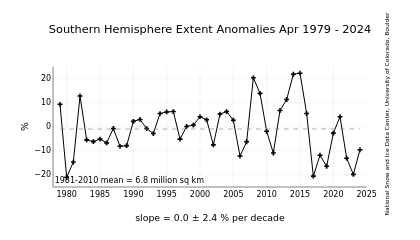
Mucho hielo alrededor de la Antártida

La banquisa de hielo marino que rodea la Antártida desaparece casi por completo al final de los veranos australes pero alcanza una extensión de casi 20 millones de km2 (40 veces la de España) al final del invierno austral (es decir, ahora).

En 1979 se iniciaron las mediciones por satélite. La medición de la extensión del hielo marino es mucho más fácil de efectuar y más fiable que el de la temperatura media y que la del volumen y el espesor del hielo
continental.

El incremento del CO2 es el mismo en el Polo Sur que en el Polo Norte. Conviene recordarlo.

Este año la extensión de los hielos marinos (y se entiende por "extensión" el área oceánica en la que la superficie está congelada en más de un 15 %) lleva muchos meses por encima de la media del período 1979-2000 (en azul, en la figura de abajo).


lunes, 21 de septiembre de 2009

Artico azul y blanco


Un tema preferido de agitación propagandística suele ser en verano el deshielo del Artico. Este septiembre los medios se han exaltado y aparentan haberse escandalizado (veáse hoy mismo El País) porque dos mercantes noruegos de la compañía Beluga hubiesen podido navegar por la costa siberiana del Artico, desde Corea hasta Siberia, aprovechando el deshielo del final del verano. Acompañados, por si acaso, de dos rompehielos nucleares rusos, admitían y escribían algunos. Según una nota del presidente de la compañía naviera, Niels Stolberg, el tránsito por el paso del nordeste de dos cargueros de tal tamaño fue posible por la gran preparación y el magnífico trabajo de equipo de los capitanes y de su tripulación, así como de unas fiables predicciones meteorológicas. Pero si necesitaron del acompañamiento de dos formidables rompehielos rusos, aunque sólo fuese para hacerles compañía, no debió salirles barato el viaje.

La verdad es que deberíamos congratularnos por la hazaña tecnológica y reaccionar de forma opuesta a la desmoralización en la que continuamente los medios tratan de hundirnos (hundiéndose primero ellos). En el colmo del delirio verborreico, el diario británico Independent titulaba : “Un triunfo para el Hombre, un desastre para la Humanidad”.

Es verdad que, a diferencia del hielo marino invernal que rodea la Antártida, que tiende a aumentar, la tendencia en las dos últimas décadas del hielo veraniego en el Artico ha sido a disminuir. Es decir, que los mínimos han tendido a ser cada vez más bajos. Pero precisamente este año no ha ocurrido así. La publicación de la hazaña de los cargueros alemanes tapa lo que debería haber sido más noticiable: este verano del 2009 el hielo marino del Artico se ha encogido menos que el año pasado y el anterior. El Artico ha estado más blanco, menos azul. Arriba pongo los mapas del 19 de septiembre del 2007 y del 2009. Como se ve en la figura, en donde con colores morados se muestra la concentración del hielo, el paso del nordeste estuvo más impracticable entonces por una barrera entre Severnaya Zemlya y el continente, pero la extensión total del hielo marino era en la misma fecha bastante menor que la actual.

Ahora, a medida que se acorta el día y el Artico se sume en la oscuridad, las temperaturas de nuevo descienden muy por debajo de cero y los primeros metros de las aguas superficiales se congelan. La extensión de esta delgada cubierta de hielo marino, desde mediados de septiembre, aumenta. De hecho ha empezado ya a aumentar. Llegará a su máximo, de nuevo, a mediados de marzo, luego se reducirá y el ciclo, dirigido por el Sol, continuará.

ref. ArticoComparacion

viernes, 7 de agosto de 2009

ice ages

Long debate ended over cause, demise of ice ages – solar and earth wobble – CO2 not main driver

6 08 2009

From an Oregon State University Media Release (h/t to Leif Svalgaard)

Long debate ended over cause, demise of ice ages – may also help predict future


The above image shows how much the Earth’s orbit can vary in shape.
This process in a slow one, taking roughly 100,000 to cycle.
(Credit: Texas A&M University note: illustration is not to scale)

CORVALLIS, Ore. – A team of researchers says it has largely put to rest a long debate on the underlying mechanism that has caused periodic ice ages on Earth for the past 2.5 million years – they are ultimately linked to slight shifts in solar radiation caused by predictable changes in Earth’s rotation and axis.

In a publication to be released Friday in the journal Science, researchers from Oregon State University and other institutions conclude that the known wobbles in Earth’s rotation caused global ice levels to reach their peak about 26,000 years ago, stabilize for 7,000 years and then begin melting 19,000 years ago, eventually bringing to an end the last ice age.

The melting was first caused by more solar radiation, not changes in carbon dioxide levels or ocean temperatures, as some scientists have suggested in recent years.

viernes, 24 de abril de 2009

Global Warming: Il problema dell'espansione dei ghiacci antartici

Neanche i più convinti assertori del Global Warming possono negarlo: i ghiacci marini antartici stanno seguendo un trend di crescita impressionante. Si presenta una nuova teoria per spiegare l'evento in atto.


immagine articolo 20031 www.newscientist.com : L'anomalia della circolazione atmosferica antartica, che prevede maggiore freddo sul Mare di Ross, e maggiore caldo attorno al Continente, in particolare sul Sud America e sulla Penisola Antartica Occidentale.

Marco Rossi: 24-04-2009 ore 07:37

Possiamo seguirlo anche da soli, l'andamento di sviluppo dei ghiacci marini antartici, che sono in decisa crescita, contrastando così quella che è la teoria generalmente accettata riguardante il Global Warming.

Attualmente, l'estensione dei ghiacci antartici è superiore alla norma trentennale (1979-2009), di circa 1,2 milioni di kmq, ma quello che conta è anche il trend di crescita trentennale in costante aumento, al contrario di quanto stanno facendo i ghiacci artici.

A questo punto è d'uopo domandarsi il perché di questo andamento che si sta verificando in un momento nel quale le temperature di tutto il Mondo sono aumentate di alcuni decimi di grado nello stesso periodo (1979-2009).

Sulla rivista New Scientist è apparso uno studio di John Turner, del British Antartic Survey.

Secondo tale studio, i ghiacci marini antartici proseguiranno ad avanzare ancora per circa un decennio, prima di iniziare anch'essi a ritirarsi, tanto da attendersi una loro riduzione di circa un terzo entro la fine di questo Secolo.

La causa sarebbe il famoso "buco dell'Ozono", causato dalle emissioni di CFC, che avrebbe interferito sulla circolazione atmosferica polare meridionale.

In pratica, tale "buco" avrebbe portato ad un approfondimento di una circolazione depressionaria fredda sul Continente Antartico, con la caduta dei venti oceanici proprio in corrispondenza del Mare di Ross, dove massima è l'espansione dei ghiacci marini, e dove le temperature sono state in calo nell'ultimo trentennio.

Invece, tra il 40° ed il 60° parallelo sud, i venti oceanici avrebbero intensificato la loro velocità, causando così un forte riscaldamento sulla Penisola Antartica e sul Sud America, che, effettivamente, hanno registrato un impressionante trend termico in aumento.

Tuttavia, considerato che tale "buco" dovrebbe richiudersi entro 50 o 100 anni, anche la decrescita dei ghiacci antartici dovrebbe essere prevalente entro circa una decina di anni, fino a perdere un terzo circa della superficie totale entro la fine di questo Secolo.

Se questo è lo stato delle cose, dal punto di vista della circolazione, la spiegazione del "Buco dell'Ozono" quale causa principale presenta, dal nostro punto di vista, alcune contraddizioni.

Tale "buco", infatti, aumenterebbe la percentuale totale di radiazione solare in arrivo sull'Antartide, in quando la parte ultravioletta non verrebbe più filtrata dall'ozono, e giungerebbe ad incrementare il bilancio radiativo positivo.

Tutto ciò varrebbe soprattutto nei mesi estivi (ed infatti il mese di Gennaio è l'unico a non presentare significativi trend di crescita dei ghiacci), mentre nei mesi invernali, quando il Sole non c'è, il surplus di radiazione ultravioletta dovrebbe essere ininfluente sulla circolazione atmosferica polare.

Presentiamo comunque questa teoria come un tentativo di spiegazione di questa apparente anomalia nell'andamento del Global Warming.

miércoles, 1 de abril de 2009

Ni idea

La temperatura global media del aire en la superficie terrestre durante el siglo pasado, parte del anterior y parte de éste, ha seguido probablemente una evolución parecida a la de la curva que publica el Servicio Meteorológico Británico en conjunción con la Universidad de East Anglia.


El siglo XX ( de la curva en el XIX no hay que fiarse demasiado) se caracteriza por una subida de unas 8 décimas de grado ocurrida en dos períodos de unos 25 años cada uno: 1922-1945 y 1975-1998.

En las explicaciones oficiales del IPCC, la primera subida, 1922-1945, suele atribuirse fundamentalmente, al incremento de la intensidad solar. Entonces, las emisiones de CO2 eran muy pequeñas y no queda más remedio que atribuirla a otras causas. El Sol puede ser una. Puede.

Luego, acabada la segunda guerra mundial, el estancamiento térmico de 1945-1975, es atribuído al efecto "enfriador" de las emisiones contaminantes de azufre que ensombrecen la atmósfera y contrarrestan a la emisión de CO2, que ya entonces, debido al desarrollo industrial occidental y soviético, era importante. Hace falta creérselo, pero para eso están los modelos.

Posteriormente, entre 1975 y 1998, según la teoría oficial, el calentamiento provocado por las emisiones de CO2 superaron de nuevo el efecto de la suciedad sufurosa, que disminuyó, y de nuevo hubo un período de calentamiento.

Ahora, lo que causa perplejidad a los teóricos que atribuyen el calentamiento al CO2 es que las temperaturas llevan sin aumentar una decena de años, desde 1998. No se sabe por qué. Y si no sabemos esto, menos sabemos aún cómo evolucionará la temperatura media global en la próxima década. Ni idea.

Por eso resulta tan ridículo el objetivo que se han propuesto los mandamases políticos occidentales de —a base de controlar las emisiones de CO2— hacer que la temperatura global media no aumente más de 2ºC, cifra mágica que se inventó Merkel y que pomposamente suelen citar. No sé si son más creídos que idiotas, o al revés.
posted by Antón Uriarte @ 12:30 PM

lunes, 9 de febrero de 2009

Record global de cosechas en el 2008

Sunday, February 01, 2009

Record global de cosechas en el 2008


Según estimaciones de la FAO en el año 2008 se produjo un nuevo record en la producción global de cereales y los stocks de reserva aumentaron un 10 %. Las mejoras de la productividad agrícola y un clima global que no va a peor, sino más bien lo contrario, propiciaron este resultado. Incluso el incremento del CO2, fertilizando el aire, contribuyó en una parte, aún no bien determinada, al aumento de las cosechas (CO2 Science).

La nota menos positiva fue que la mayor parte del incremento ocurrió en los países desarrollados y el crecimiento en los países subdesarrollados fue muy pequeño, aunque no en todos. Hubo un boom en la producción cerealística del Sahel, la franja de países al sur del Sahara, en donde las abundantes lluvias propiciaron la excelente cosecha.

El hambre persiste en muchos países, pero no por razones climáticas sino esencialmente políticas, como en Zimbawe y Corea del Norte. Es criminal atribuirlo al clima.

domingo, 11 de enero de 2009

Pravda: Earth on the brink of an ice age


Pravda: Earth on the brink of an ice age
argues that those nice 12,000 warm years are approaching their end and the following 100,000 years will impress us with a new ice age. ;-)

Well, there is surely a potential for a 5-8 °C cooling in a few thousands years (or tens of thousands of years) - because the human civilizations that we know from the history textbooks already started in an unusually warm period (see the scary left side of the last, black graph on the image below) - but should we expect the cooling soon?
Update: David Archibald has reminded me of this picture (with an imminent icy prediction) from the 2000 article in Science by Berger and Loutre. Archibald included it in his cute book, Solar Cycle 24, as Figure 3.
Well, an imminent cooling is surely possible but the article doesn't look like the most convincing piece of science to me - both because of technical reasons, missing references, as well as entertaining, otherwise unimportant mistakes (for example, they claim that the Serbian astronomer Milutin Milanković was Czech).


But I would like to ask you what you know and think about the reconstruction of the climate record from the Milankovitch cycles. How good a fit can we actually obtain by combining the known astronomical cycles with well-chosen coefficients?

There are indications that the purely astronomical theory fails to describe very low-frequency signals - with approximately 100,000-year or 400,000-year periodicity - whose observed amplitude seems to be much larger than the theoretically predicted one: natural climate change at very long timescales seems to be much more intense than our theories say.

But when you ignore this 100k problem and 400k problem, can you actually reconstruct some nontrivial portions of the observed temperature profile or is the Milankovitch theory mostly a "proposal" that things should work like this that hasn't been satisfactorily verified?

There are many other effects one could imagine to be relevant, including new kinds of "sonic" cycles inside the Sun and/or varying intensities of cosmic rays caused by the motion of the solar system through different galactic patches.

I am probably going to play with Mathematica and Fourier series for a while.


Bonus: music and global warming

Because
the mostly natural warming since the 17th century has changed the sound of wooden instruments,
a statement that sounds funny but I find it perfectly plausible, Joe D'Aleo recommends Michael Mann to include violins in the list of his favorite proxies. The rapid increase of electronic instruments in the recent years will become just another proof of the hockey-stick-shaped, catastrophic man-made global warming. ;-)

Polar Sea Ice Changes are Having a Net Cooling Effect on the Climate

A guest post by Steven Goddard
One of the most widely discussed climate feedbacks is the albedo effect of polar sea ice loss. Ice has a relatively high albedo (reflectance) so a reduction in polar ice area has the effect of causing more shortwave radiation (sunlight) to be absorbed by the oceans, warming the water. Likewise, an increase in polar sea ice area causes more sunlight to be reflected, decreasing the warming of the ocean. The earths radiative balance is shown in the image below. It is believed that about 30% of the sunlight reaching the earth’s atmosphere is directly reflected - 20% by clouds, 6% by other components of the atmosphere, and 4% by the earth’s surface.
Radiation & Climate Slide
We all have heard many times that summer sea ice minimums have declined in the northern hemisphere over the last 30 years. As mentioned above, this causes more sunlight to reach the dark ocean water, and results in a warming of the water. What is not so widely discussed is that southern hemisphere sea ice has been increasing, causing a net cooling effect. This article explains why the cooling effect of excess Antarctic ice is significantly greater than the warming effect of missing Arctic ice.
Over the last 30 years Antarctic sea ice has been steadily increasing, as shown below.
http://nsidc.org/data/seaice_index/images/s_plot.png

December is the month when the Antarctic sun is highest in the sky, and when the most sunlight reaches the surface. Thus an excess of ice in December has the maximum impact on the southern hemisphere’s radiative balance. In the Antarctic, the most important months are mid-October through mid-February, because those are months when the sun is closest to the zenith. The rest of the year there is almost no shortwave radiation to reflect, so the excess ice has little effect on the shortwave radiative (SW) balance.

This has been discussed in detail by Roger Pielke Sr. and others in several papers.
So how does this work? Below are the details of this article’s thesis.
1. As mentioned above, the Antarctic ice excess occurs near the December solstice when the sun is highest above the horizon. By contrast, the Arctic ice deficiency appears near the equinox - when the sun is low above the horizon. Note in the graph below, that Arctic ice reaches it’s minimum in mid-September - just when the sun is setting for the winter at the North Pole. While the September, 2008 ice minimum maps were dramatic, what they did not show is that there was little sunlight reaching the water that time of year. The deviation from normal did not begin in earnest until mid-August, so there were only a couple of weeks where the northern hemisphere SW radiative balance was significantly impacted. Thus the water in most of the ice-deficient areas did not warm significantly, allowing for the fast freeze-up we saw during the autumn.
The 2008 peak Arctic ice anomaly occurred near the equinox, when it had the minimum heating effect on the ocean.
http://www.ijis.iarc.uaf.edu/seaice/extent/AMSRE_Sea_Ice_Extent.png
By contrast, the peak Antarctic ice anomaly occurred at the December solstice, when it had a maximum cooling effect, as shown below.
http://nsidc.org/data/seaice_index/images/daily_images/S_timeseries.png
2. The next factor to consider is the latitude of the ice, which has a strong effect on the amount of solar insolation received. Arctic sea ice is closer to the pole than Antarctic sea ice. This is because of the geography of the two regions, and can be seen in the NSIDC images below.
http://nsidc.org/data/seaice_index/images/daily_images/N_daily_extent.png
http://nsidc.org/data/seaice_index/images/daily_images/S_daily_extent.png
Antarctic sea ice forms at latitudes of about 55-75 degrees, whereas most Arctic ice forms closer to the pole at latitudes of 70-90 degrees. Because Antarctic ice is closer to the tropics than Arctic ice, and the sun there reaches a higher angle above the horizon, Antarctic sea ice receives significantly more solar radiation in summer than Arctic sea ice does in its’ summer. Thus the presence or absence of Antarctic ice has a larger impact on the SW radiative balance than does the presence or absence of Arctic ice.
At a latitude of -65 degrees, the sun is about 40 degrees below the zenith on the day of the solstice. Compare that to early September negative anomaly peak in the Arctic at a latitude of 80 degrees, when the sun is more than 70 degrees below the zenith. The amount of solar radiation hitting the ice surface at those maxima is approximately 2.2 times greater in the the Antarctic than it is in the Arctic = cos(70) / cos(40) .
The point being again, that due to the latitude and date, areas of excess Antarctic ice reflect a lot of SW radiation back out into space, whereas deficient Arctic ice areas allow a much smaller quantity of SW radiation to reach the dark surface of water. Furthermore, in September the angle of incidence of the sun above the water is below the critical angle, so little sunlight penetrates the surface, further compounding the effect. Thus the Antarctic positive anomaly has a significantly larger effect on the earth’s SW balance than does the Arctic negative anomaly.
3. The next point is an extension of 2. By definition, excess ice is further from the pole than missing ice. Thus a 10% positive anomaly has more impact on the earth’s SW balance than does a 10% negative anomaly.
4. Due to eccentricity of the earth’s orbit, the earth is 3% closer to the sun near the December solstice, than it is during the June solstice. This further compounds the importance of Antarctic ice excess relative to Arctic ice deficiency.
All of these points work together to support the idea that so far, polar ice albedo feedback has been opposite of what the models have predicted. To date, the effect of polar albedo change has most likely been negative, whereas all the models predicted it to be positive. There appears to be a tendency in the climate community to discount the importance of the Antarctic sea ice increase, and this may not be appropriate.

CO2 en el 2008: ¿ incremento mínimo ?

El dato preliminar del incremento atmósferico de CO2 en el 2008, registrado en el Mauna Loa (observatorio oficial de sus mediciones), ha sido el más bajo desde que comenzaron las mediciones en 1959: 0,24 partes por millón (ppm). (CO2 trends) .

Pero ...quizás sea un error. Es extraño que en la tabla Mauna Loa CO2 monthly mean data la cifra del mes de Diciembre sea la misma exactamente que la de Noviembre: 384,11 ppm.

Las emisiones de CO2 por quema de combustibles fósiles habrán sido de unas 29 gigatoneladas (ver gráfica abajo), que de haberse quedado por completo en la atmósfera hubiesen aumentado la concentración de CO2 en unas 3,7 partes por millón. Así que falta en el aire la mayor parte del CO2 añadido en el 2008, que habrá sido absorbido por el mar y la biomasa terrestre (suelos y vegetación). Más que de costumbre.


Gt (Gigatonelada) = mil millones de toneladas
2,12 Gigatoneladas de carbono (7,8 Gigatoneladas de CO2) equivalen a 1 ppm en la concentración atmosférica de CO2.


Los interesados sobre la variabilidad del aumento del CO2 pueden leer :
Incremento del CO2

ref. datos de la gráfica: EIA - International Energy Data and Analysis .


Riscaldamento globale, un'ipotesi diversa. Parte I: il minimo di Gleissberg

Il ritardo del nuovo ciclo solare potrebbe indurre a un ripensamento circa alcune idee riguardanti le cause dei cambiamenti climatici.


immagine articolo 19372 Confronto fra l'andamento dei cicli solari 22-23 e 3-4, secondo l'ipotesi che, nei prossimi anni, prevede una replica del minimo di Dalton. Fonte: http://ncwatch.typepad.com. Clickare l'immagine per ingrandire.

Stefano Di Battista: 10-01-2009 ore 11:19

Il ritardo con cui il ciclo solare 24 si sta manifestando ha riportato l'attenzione sul ruolo dell'astro quale motore del clima terrestre: una più approfondita conoscenza di tali connessioni potrebbe infatti rimettere in discussione alcune idee circa il riscaldamento globale di origine antropica. Di qui le ricerche e gli studi, attraverso cui la comunità scientifica si sta interrogando; in particolare, si cercano le prove riguardanti il minimo di Gleissberg che, se avesse fondamento nei suoi presupposti teorici, potrebbe condurre la Terra a un accentuato raffreddamento. Alla base dei nuovi scenari sta il comportamento del Sole negli ultimi anni: non è chiaro cosa stia avvenendo, e ciò è motivo di interpretazioni diverse, che qui si riassumono per sommi capi.

Debolezza del ciclo 24 Il 4 gennaio 2008, alle alte latitudini solari, è comparsa una macchia a polarità invertita, indizio del nuovo ciclo, il 24º dal 1755, anno da cui inizia la classificazione numerica. Tuttavia l'attività dell'astro si è mantenuta bassa, al contrario delle attese, che indicavano un pronunciato massimo entro il 2010 (poi spostato al 2011, al 2012 e ancora oltre). Nell'ottica di tale massimo, ci si attendeva una progressiva crescita dell'attività solare; invece, il 2008 (266 giorni secondo i dati preliminari) è risultato l'anno con meno macchie (Spotless days) dal 1913, il 4º per scarsità dal 1849 in una classifica che vede, al 19º posto, anche il 2007 (163 giorni). Ciò ha fatto postulare che il ciclo 24 possa rassomigliare ai cicli di fine Ottocento - inizio Novecento, quando l'attività del Sole era meno marcata dell'attuale.

Ampiezza del ciclo 23 Il 28 marzo 2008 la sonda SOHO (Solar and Heliospheric Observatory) ha confermato l'apparizione sul Sole d'un gruppo di macchie della precedente polarità a latitudini equatoriali: per gli specialisti questa è la prova che il ciclo 23 non è ancora esaurito. In effetti, nel trapasso da un ciclo all'altro, la sovrapposizione fra il vecchio e il nuovo è cosa normale; tuttavia, se il ciclo 23, iniziato nel maggio 1996, non fosse terminato, starebbe per raggiungere l'ampiezza del ciclo 4 (1784-'98) confermando, almeno in parte, la teoria del ciclo di Gleissberg.

Detto ciò, si rendono necessarie alcune considerazioni aggiuntive. La scarsità di macchie solari di per sé non ha incidenza sul clima terrestre; esse non sono che un indicatore dell'attività magnetica dell'astro, nel senso che appaiono in numero elevato quanto più il Sole è attivo, e viceversa. È appurato che lunghi minimi solari, caratterizzati dalla scomparsa quasi totale delle macchie, sono coincisi con fasi fredde ultrasecolari, tant'è che «la corrispondenza tra due segnali non periodici, cioè i documenti della storia del clima e il profilo della variabilità solare nel lungo periodo, ben si adattano l'uno all'altro, quasi come una chiave e la sua toppa» [Eddy, pp. 195-196].

Se il ciclo 23 non è esaurito (si avvierebbe quindi a raggiungere i 13 anni), la corrispondenza col ciclo 4 (durato 13,6 anni) permetterebbe di formulare previsioni a lungo termine. Secondo la teoria di Gleissberg, cicli molto ampi (e il ciclo 4 è stato il più ampio tra quelli numerati) preludono a una fase di quiescenza solare (vedi nota), che si mostrerebbe nei cicli successivi, a partire dunque dal 24º o, più probabilmente, dal 25º. L'analogia è data dal minimo di Dalton (1798-1823), che si produsse coi deboli cicli 5 e 6 e che corrispose alla fase terminale della Piccola età glaciale, quando molte morene alpine raggiunsero il loro limite storico. Ma c'è un'ulteriore complicazione, fra le tante che rendono estremamente difficile interpretare il ruolo del Sole.

Il ciclo perduto Analizzando la scarsità di osservazioni successive al 1790 (imputate all'instabilità socio politica derivante dalla Rivoluzione francese), si è ipotizzato che l'apparente lunga durata del ciclo 4 sia stata, invece, il risultato della sovrapposizione di due cicli: uno denominato 3' (1784-'93) e un debole, e non riconosciuto, ciclo 4 (1793-'99), circostanza che farebbe leggermente postdatare l'avvio del ciclo 5 (1799 in luogo del 1798). Il declino eccezionalmente lungo del ciclo 4 (fase catastrofe: 1791-'98) pertanto, sarebbe da inquadrare in modo diverso rispetto a quanto ritenuto finora [Usoskin, pp. 257 e 259].

A prescindere dalle implicazioni storiche e dai risvolti astrofisici che questa lettura può comportare, lo spunto riguardante le carenze della documentazione conduce a una riflessione circa il minimo attuale. Tra il 21 luglio e il 10 settembre 2008 si era creduto di archiviare una sequenza spotless di 51 giorni, che sarebbe stata la più lunga dal 1913 e la quarta dal 1849; l'osservatorio di Rimavská Sabota (Slovacchia) ha tuttavia riconosciuto un gruppo di macchie che hanno interrotto la sequenza al 20 agosto (31 giorni). Ciò non va a inficiare l'importanza del minimo attuale, ma apre anzi una questione cruciale, ovvero: quanto sono attendibili, secondo i parametri in uso, i minimi di fine Ottocento e inizio Novecento, per non parlare di quelli del XVII e XVIII secolo, quando le tecniche di rilevamento erano notevolmente meno affinate delle attuali? Quante altre macchie, del tipo di quelle messe in evidenza nel 2008, possono esser sfuggite agli astronomi dell'epoca? Perciò: la fase di quiescenza odierna è esattamente confrontabile con quelle passate, oppure è sottostimata per via d'una più capillare capacità di controllo?

Nessuna risposta è al momento opportuna, anche perché gli stessi sostenitori delle implicazioni climatiche derivanti dall'attività solare mettono in luce una serie di incongruenze che ancora attendono una spiegazione.

Note
Tale quiescenza determinerebbe anche una debolezza del vento solare, esponendo così la Terra a una maggiore ingerenza dai raggi cosmici: da qui l'ulteriore teoria di Henrik Svensmark ed Eigil Friis-Christensen, del Dansk Rumforskningsinstitut di Copenaghen, a parere dei quali ciò indurrebbe un aumento della nebulosità terrestre.

Bibliografia
J.A. EDDY, Il clima e il ruolo delle condizioni solari, in R.I. ROTBERG, T.K. RABB (a cura di), Clima e storia, Milano, 1984, pp. 170-197.
I.G. USOSKIN, K. MURSULA, G.A. KOVALTSOV, The start of the Dalton minimum: was one sunspot cycle lost in late XVIII century?, in H. SAWAYA-LACOSTE (editor), Proceedings of the Second Solar Cycle and Space Weather Euroconference (Vico Equense, Italy, 24-29 settembre 2001), Noordwijk, 2002, pp. 257-260.

Riscaldamento globale, un'ipotesi diversa. Parte II: le previsioni di Hathaway

immagine articolo 19419 Le ultime due previsioni (ottobre 2008 e gennaio 2009) elaborate da David H. Hathaway del NASA Marshall Space Flight Center, che riducono l'ampiezza del ciclo 24: il massimo scende al di sotto di quello del ciclo 23 (fonte:
www.Klimadebat.dk . Clickare sull'immagine per ingrandire).

Stefano Di Battista: 11-01-2009 ore 21:02

I sostenitori del riscaldamento globale antropico hanno una posizione perentoria: «Tutte le teorie che hanno cercato di attribuire alla radiazione solare un ruolo determinante sull'andamento delle temperature nell'ultimo secolo e, in particolare degli ultimi 50 anni, non reggono» [Caserini, p. 103]. Eppure ci sono studi che mostrano come la componente solare spieghi il 74% dell'evoluzione termica dell'emisfero boreale dal 1610 al 1800 e il 56% di quella successiva, e pur avvertendo che solo un terzo degli 0,36 °C di aumento registrati dal 1970 sono attribuibili alla variabilità solare, concludono che essa «può aver giocato un ruolo più grande nel recente mutamento di temperature globali di quello che finora è stato riconosciuto» [Lean, p. 3198].

Il filo che lega Sole e clima terrestre sembra correlato ad alcune componenti che possono amplificarne, oppure limitarne, gli effetti. Nella sintesi seguente si descrivono quelle su cui, al momento, si concentrano le maggiori attenzioni.

Fasi solari Il ciclo delle macchie ha una periodicità di 11,2 anni (ciclo di Schwabe); si tratta d'un dato medio, poiché sono documentati cicli di 9 anni e altri di 14. Il passaggio da un ciclo all'altro è determinato dall'inversione della polarità delle macchie, il che implica che ogni 22 anni circa (ciclo di Hale) il campo magnetico del Sole torni allo stato iniziale. La durata dei cicli di Schwabe è correlata al ciclo di Gleissberg, di 80-90 anni: ogni fase alternerebbe cicli lunghi, in cui il Sole si mostra meno dinamico, e cicli corti, in cui l'attività magnetica s'intensifica. A supporto di tale ipotesi si fa notare come i cicli 16-22 (si esclude il 23 poiché ancora non esiste certezza circa il suo esaurimento) abbiano avuto una durata media di 10,4 anni e un basso numero di Spotless days, mentre i cicli 10-15 (1856-1923), quelli cioè per cui risulta più certo il conteggio delle macchie (la compilazione storica regolare ebbe inizio nel 1849, durante il ciclo 9), siano durati in media 11,3 anni e con un più alto numero di Spotless days (*),

Eruzioni vulcaniche Un grande capitolo, su cui esiste accordo pressoché unanime nel mondo scientifico, è quello dell'influenza sul clima delle polveri vulcaniche immesse nella stratosfera. Il Dust veil index (DVI) è stato elaborato per misurarne la concentrazione. Se si scorrono le tavole cronologiche di tale indice, si noterà come il minimo di Dalton sia coinciso con una forte attività vulcanica: fra il 1799 e il 1822 (cicli 5 e 6) ci furono non meno di 12 eruzioni [Lamb, pp. 434-435], tra cui quella del Cotopaxi (Ecuador) nel 1803 (DVI = 1.100 circa) e quella del Tambora (Indonesia) nel 1815 (DVI = 3.000). Il XIX secolo e l'inizio del XX furono caratterizzati da un'altissima attività vulcanica (**), ma poi subentrò una stasi e «poiché le eruzioni vulcaniche hanno segnato un minimo marcato tra il 1912 e il 1948, tale situazione ha certamente favorito il sensibile aumento della temperatura verificatosi in quel periodo» [Pinna, p. 174].

Teleconnesioni Si ritiene che, durante le fasi di forte attività magnetica del Sole, ENSO (El Niño Southern Oscillation) sia preponderante rispetto alla Niña e viceversa. A partire dal 1976, in coincidenza coi cicli 22 e 23, ENSO avrebbe avuto un non trascurabile impatto sulle variazioni climatiche. Stando al ciclo di Gleissberg, nei prossimi anni è attesa una prevalenza della Niña, con conseguente moderazione degli eccessi climatici notati a cavallo del XXI secolo. Anche la PDO (Pacific Decadal Oscillation) e la NAO (North Atlantic Oscillation) sembrano correlate al ciclo solare, ed entrambe starebbero entrando in una fase negativa (fase fredda), che andrebbe a sommarsi alla debolezza di ENSO, amplificando gli effetti d'un minimo solare sul quadro termico terrestre. Si è poi tentato di mettere in relazione al ciclo undecennale anche la QBO (Quasi-Biennal Oscillation), ma con risultati di difficile valutazione.

Questo insieme di elementi potrebbe spiegare, almeno in parte, il riscaldamento dell'ultimo secolo e fornire indicazioni probabilistiche sulla futura evoluzione del clima terrestre. In questo campo di studi, mettendo in relazione l'indice geomagnetico del Sole e lo Zürich Sunspot Number (ovvero il conteggio delle macchie), si è scoperto che esiste una forte somiglianza (di segno inverso, però) fra il minimo di Maunder (1645-1723) e il grande massimo solare del XX secolo. Nel 1923 infatti (inizio del ciclo 16), si evidenzia una brusca variazione nell'ampiezza e nella durata della curva di lungo periodo che descrive l'attività solare; essa raggiunge l'apice intorno al 1960, poi comincia a decrescere [Duhau, pp. 8-9 e 14], in una parabola che dovrebbe riportarla al punto zero proprio con l'inizio del ciclo 24.

Ciò che, a oggi, si può affermare, è che il ciclo 23 è stato più lungo dei precedenti ma caratterizzato da meno macchie solari. Quanto al ciclo 24, le proiezioni elaborate negli scorsi anni lo descrivevano come il più forte degli ultimi secoli; la comparsa del nuovo massimo, invece, è stata via via posticipata e ridimensionata. David H. Hathaway, del Marshall Space Flight Center, considerato il maggior esperto mondiale in fatto di previsioni dell'attività solare, per tre volte ne ha riveduto l'ampiezza (Maximum sunspot number); ecco i dati che ha proposto:
145 (nel marzo 2006)
137 (nell'ottobre 2008)
104 (nel gennaio 2009)

Sorprendente l'ultima, forte correzione, ad appena tre mesi dalla precedente che, se confermata, condurrebbe a un debole ciclo 24 come non si verifica dal ciclo 16 (1923-'33). D'altro canto, la quiescenza del Sole nel 2007-'08 e in quest'inizio del 2009 è fonte di incertezze, che vanno a rafforzare la possibilità che il ciclo di Gleissberg conduca a un accentuato minimo verso il 2030: cosa questa che, combinandosi con le fasi negative delle principali teleconnessioni, potrebbe determinare un progressivo raffreddamento del clima terrestre, in antitesi a quanto postulato dalla teoria del riscaldamento globale antropico. Una possibilità, si è detto, che trova fondamento in una ciclicità abbastanza chiara dell'attività solare, la cui componente magnetica resta tuttavia un sistema caotico e non lineare, sull'evoluzione della quale è bene esercitare cautela: altrimenti si rischia quella che è stata definita ciclomania [Le Roy Ladurie, p. 13], che pretenderebbe di descrivere il clima futuro con estrapolazioni statistiche molto lontane dalla realtà dei fatti.

Note
Questa corrispondenza è resa dal grafico pubblicato a corredo dell'articolo http://www.meteogiornale.it/news/read.php?id=19367.
* Si è anche ipotizzato che l'intensità del vento solare, influenzando le linee di flusso del campo magnetico terrestre, possa modulare l'attività vulcanica; si tratta però d'una supposizione rimasta finora a livello accademico.

Bibliografia
S. CASERINI, A qualcuno piace caldo, Milano, 2008.
S. DUHAU, C. DE JAGER, The Solar Dynamo and Its Phase Transitions during the Last Millennium, in «Solar Physics», vol. 250, n. 1 (2008), pp. 1-15 (doi: 10.1007/s11207-008-9212-x).
H.H. LAMB, Climate: Present, Past and Future, vol. I, Londra, 1972.
J. LEAN, J. BEER, R. BRADLEY, Reconstruction of solar irradiance since 1610: Implications for climate change, in «Geophysical Research Letters», vol. 22, n. 23 (1995), pp. 3195-3198.
E. LE ROY LADURIE, Tempo di festa, tempo di carestia, Torino, 1982.
M. PINNA, Le variazioni del clima, Milano, 1996.

Parte I: http://www.meteogiornale.it/news/read.php?id=19372

viernes, 9 de enero de 2009

El carbón es más seguro


Fríos del este sobre Europa. Apetece carbón, pero la política contra el CO2 ha favorecido en los últimos años la construcción de centrales térmicas de gas.

Emitir una tonelada de CO2 cuesta hoy unos 15 euros a los que firmaron el Protocolo de Kyoto sin detenerse a saber lo que firmaban. Como en la producción de un kWh de electricidad producido con carbón se emite el doble de CO2 que si se produce con gas, los políticos, vigilados por los talibanes del cambio climático, vienen favoreciendo a este último.

Pero hay por el mundo mucho más carbón que gas. Las reservas conocidas superan un siglo. Y están mejor repartidas, por lo que el abastecimiento es mucho más seguro.

Estos días la prensa deja caer la idea de que los cortes de gas ruso, por su negativa a suministrar a Ucrania, que lo roba, no son más que ganas de chulear a Europa, como si el gas en Rusia sobrara. No es así. La producción de gas en Rusia en 2007 fue menor que en 2006 y equivalente a la de 1991. Y en Rusia también pasan frío. Pongo una gráfica sobre la producción de gas en Rusia, diferenciando la cantidad que consumen ellos mismos y la cantidad que exportan. No andan muy sobrados. De lo que andan bastante mejor es precisamente de carbón.

España, con una larga costa, unos buenos buques y unas tradicionales y buenas instalaciones portuarias debería en el futuro hacer que el carbón, y no el gas, fuese su principal fuente de electricidad. Sin embargo, los precios impuestos a las emisiones de CO2 han llevado a las compañías a optar por otra fuente más cara e insegura.

Eso creo, aunque seguro que para algunas empresas, con la complicidad de los gobiernos, la opción de abandonar el carbón y jugar en compraventas de CO2 y subvención de renovables es también un buen negocio, que quizás compensa.

sábado, 3 de enero de 2009

RESUMEN

ALBUM J-ALBUM 8.1 ENLACE


image

FLICKR ENLACE

image

PHOTOBUCKET


Photobucket

ALBUM PHOTOBUCK ENLACE


image


PHOTOBUCKET SLIDESOW PEGADO


FLICKR PEGADO


ALBUM PICASA PEGADO
nieve panti

ALBUM PICASA ENLACE